About
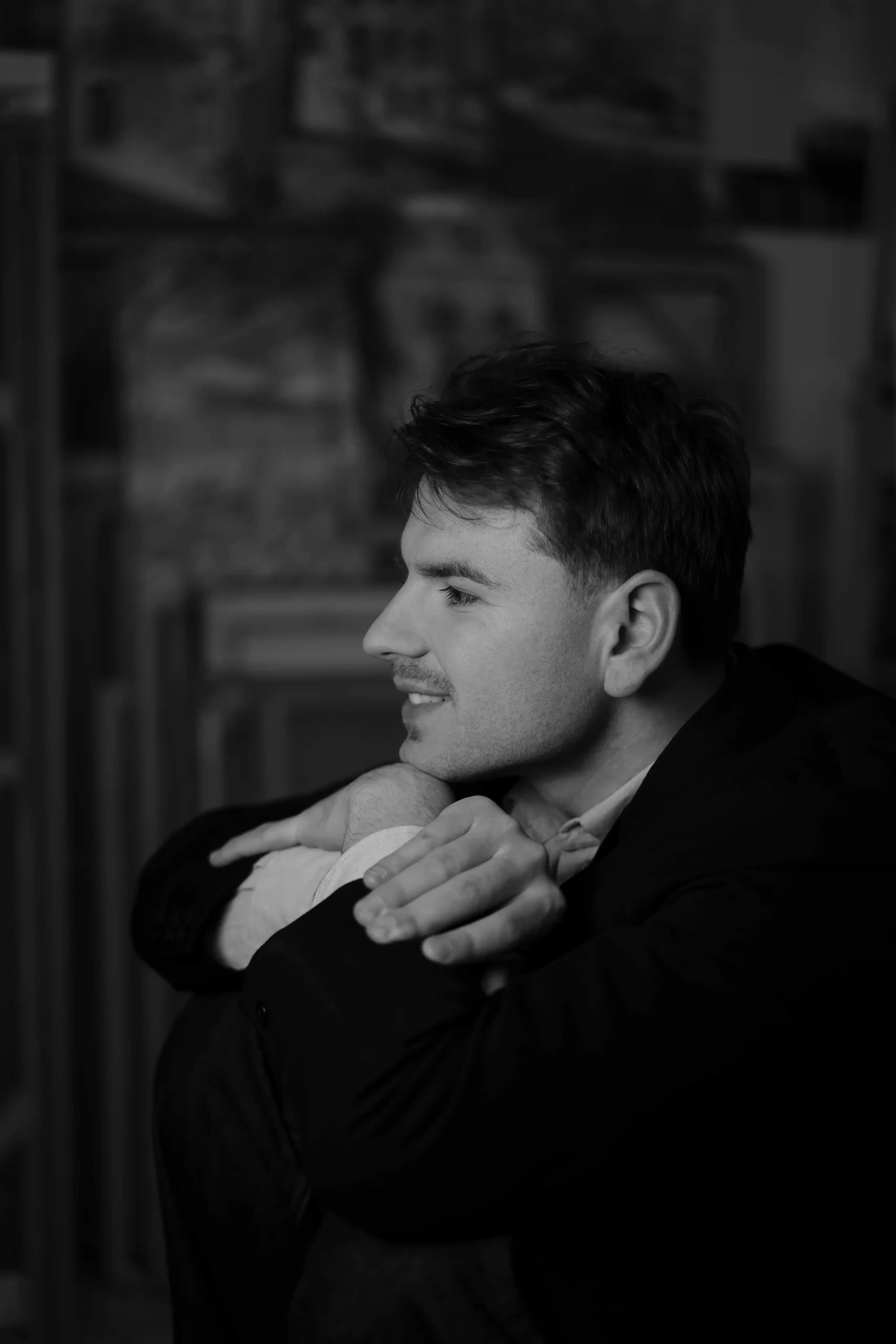
Sergiu Ciochina (b. 2001) is a Paris-based painter whose landscape practice operates through a form of recognition. What these works offer is not geography, but a system of states—space becomes a carrier of memory, time, and inner tension. Without resorting to the human figure, the paintings maintain a constant sensory presence—almost physical. They do not explain or illustrate; they create the conditions for a silent encounter between the viewer and the image.
This selection brings together landscapes created in Moldova, Italy, Norway, and France. Yet the itinerary is less important than the continuity of the gaze. Regardless of location, the works follow the same principles: the suspension of time and the construction of the image through light and color rather than narrative.
The absence of people is essential. It is not an aesthetic preference but a conceptual decision: without the figure, the viewer can no longer consume the painting as a scene. There is no gesture, action, or imposed direction of reading. Instead, an open state of availability emerges. The landscape is not simply “seen,” but mentally inhabited. Each work proposes a space where the gaze moves slowly, unguided by a narrative center. Nothing dominates; everything coexists.
Light is central—not as a natural phenomenon, but as pictorial matter. In these works, light does not fall upon things; it constructs them. Surfaces are generated from color: ultramarine blue, natural sienna, cobalt violet, and pale pink do not describe a time of day so much as intensities. They function as emotional frequencies that alter the perception of space. A house, a cliff, a street, or a balcony often feels on the verge of dissolving or reconfiguring itself, as if the painting were capturing continuous transition—of the subject and of the painter’s control over it.
This controlled instability defines the series. Even when an image suggests calm, a subtle tension persists between structure and dissolution. Brushstrokes remain visible; layers are not smoothed out; the texture stays active. Time is not merely represented—it is embedded in the work’s materiality.
Although certain affinities may echo European painting histories, these works refuse nostalgia. They demand a direct encounter rather than a reading through citation. In an era of accelerated visual consumption, they ask for duration: to stay, to return, to recalibrate perception. Painting becomes an interval of deceleration—where meaning is not fixed but continuously negotiated between viewer and image.
Alongside his figurative paintings, Ciochina’s landscapes form an equally important body of work. Rather than depicting specific locations, they transform remembered places into emotional spaces shaped by light, colour and atmosphere. Together, these two directions reveal a coherent artistic language in which memory becomes the true subject of painting.
The Landscapes (2025) presents a curated selection of paintings created between 2021 and 2025, tracing the evolution of Ciochina’s exploration of memory, atmosphere and the emotional resonance of place.
Figurative art